If you go to Son La or
Dien Bien, you can't miss the story of King Thai Deo Van Long; if you go to Lao
Cai, you can't miss hearing about the Hmong King Hoang A Tuong; and if you go to
Ha Giang, you must know about the father and son, the Hmong King Vuong Chinh Duc
and Vuong Chi Sinh -
Ha Giang Tours
But before mentioning the Hmong King and his son, we cannot fail to mention the
historical migration of the Hmong people from the North to the South.
The Dong Van Stone Plateau is a land where the Hmong, Lo Lo, Tay, Dao, and other
17 ethnic groups have lived together for generations. According to historical
records, the Hmong appeared in Dong Van around the late 17th and early 18th
centuries, later than other ethnic groups. However, the Hmong are the most
dominant ethnic group, accounting for 77% of the population of the Dong Van
region, and are also the ethnic group that has left the most significant mark on
this land.
The Hmong were once a large ethnic group living in the Jingzhou-Jianghuai region
(now part of Hunan and Guizhou provinces, China), part of the Miao-Yao tribal
alliance formed over a period of 5000 years. Throughout their history, the Hmong
in Jingzhou-Jianghuai shared a common characteristic with the Vietnamese people:
they were constantly threatened by the Han dynasty from the north.
During the Han dynasty's most prosperous period, the Han army unified China,
subdued major tribes, and invaded neighboring countries. In China, the Hmong
were a large ethnic group that the Han dynasty both hated and resented. The
Hmong, intelligent, courageous, and exceptionally brave, were considered by the
Han dynasty to be a threat to the survival of the Han dynasty, so for
generations, Han emperors sent troops to subdue the Hmong. But the Han conquests
all failed due to the fierce resistance of the Mongols.
However, to protect the survival of their people, the Mongols in
Jingzhou-Jianghuai paid a heavy price. Each century, wars caused the Mongol
population to dwindle, with the elderly, women, and children outnumbering men.
At the end of the 17th century, a fierce battle occurred between the Mongol clan
and the Han dynasty.
The Mongol leader in Jingzhou-Jianghuai then rallied the men to rise up against
the Han dynasty once again. This was also the battle that inflicted the greatest
losses on the Mongols, driving them south. After this battle, faced with the
casualties suffered by his people, the Mongol leader in Jingzhou-Jianghuai made
a final decision to protect his race and to permanently free his people from
further territorial wars.
The leader called upon the Hmong people: "All the great clans, go south. Go to
the highest, most remote lands, places no one has ever set foot in, and stop
there, build houses, cultivate fields, marry, and have children. That will be
the new homeland of the Hmong people."
Following the call of that Hmong leader, the Hmong people in Jingzhou-Jianghuai
(in Guizhou province) left their homeland and migrated south in the largest
migration in the history of the Hmong people. This migration brought the Hmong
people to the northern regions of Vietnam. The command given by the Hmong leader
was strictly followed by the Hmong people: they chose the highest, most remote,
and most desolate mountainous areas to settle and establish new homelands and
villages. This explains the Hmong people's habit of living in sparsely populated
mountainous areas.
During that migration, the Dong Van Karst Plateau was one of the places chosen
by the Hmong people as their new homeland. Even now, the Hmong people of Ha
Giang still recount their ethnic history through songs: "Guizhou is the beloved
homeland of our Hmong people. Because our Hmong people were poor and hungry,
because our Hmong people were illiterate, and lost their land to the Han Chinese
in a lawsuit, because our Hmong people were illiterate, we had to move our
homeland to this land".
The migration of the Hmong people to the Dong Van karst plateau marked a
significant period in the history of the Hmong people, with the formation of
Hmong kings whose prestige resounded throughout the northern mountainous region.
At the beginning of the 18th century, Dong Van had around 100,000 Hmong people,
including the Vang, Duong, and Ma clans…the largest clans. Each clan had its own
customs, its own worship practices and way of life, in addition to the
characteristic customs of the Hmong people. Each clan also had a leader
unanimously elected by the entire clan. These clan leaders were responsible for
protecting the safety and vitality of the entire clan, and most came from the
most prestigious and wealthy families within the clan.
However, King Vuong Chinh Duc - the first Hmong King in Dong Van - did not have
such a noble background. King Vuong Chinh Duc came from a poor family. He was
the son of a poor Hmong family named Vang. Before being known as Vuong Chinh
Duc, he was born in Sa Phin - Dong Van with the name Vang Dung Lung. Vang Dung
Lung had a difficult childhood. His father died at a young age, and Vang Dung
Lung had to...
But Vuong Chinh Duc - the first Hmong King of Dong Van - did not come from such
a noble background. King Vuong Chinh Duc was from a poor family. He was the son
of a poor Hmong family named Vang. Before being known as Vuong Chinh Duc, he was
born in Sa Phin, Dong Van, under the name Vang Dung Lung. Vang Dung Lung had a
difficult childhood. His father died at a young age, and he had to work hard
with his mother and older brother, Vang Tra Po, to survive. But the elders in
Dong Van, especially in Sa Phin - the hometown of Vuong Chinh Duc - Vang Dung
Lung, say that his parents, grandparents, and those who witnessed his growth all
saw early on the characteristic temperament of an intelligent, courageous Hmong
person, always exploring the land around him.
From a young age, Vang Dung Lung was very active and intelligent. At the age of
10, Vang Dung Lung was already wandering on foot through the high mountains of
Meo Vac. There wasn't a single village he hadn't visited. There wasn't a single
Hmong person in Dong Van he hadn't met. Vang Dung Lung usually only returned
home when he suddenly realized he had been away for too long, and often when he
came home, his mother almost didn't recognize her son, who seemed to have aged
and become more experienced with each departure. By his youth, Vang Dung Lung
was a brave and courageous Hmong young man, unafraid of tigers or wild animals
when venturing into the forest, and renowned throughout the high mountains of
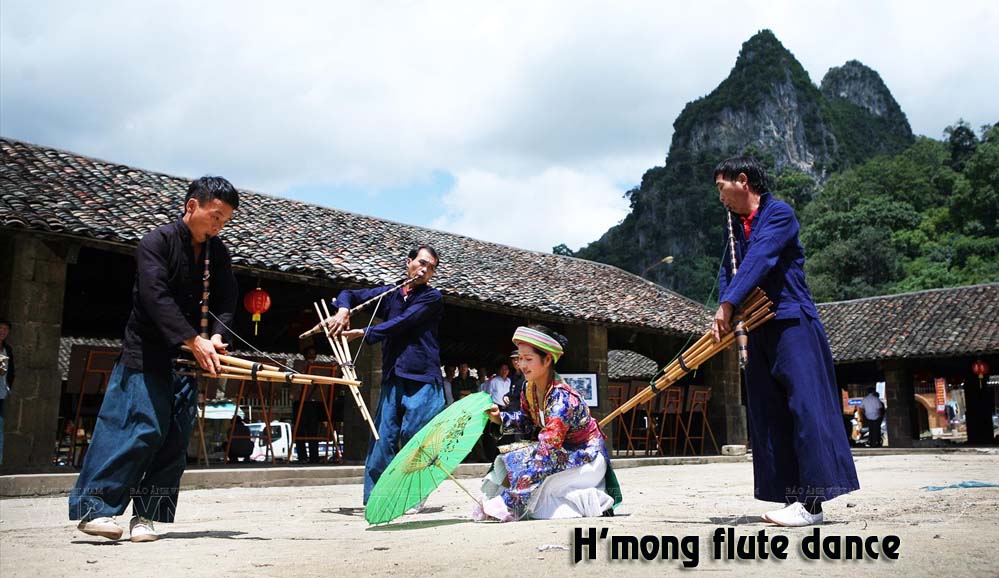
Dong Van for his masterful flute playing.
When the Hmong began their migration south and settled in Dong Van, the Hmong
leader, whose story is passed down in Hmong history, dreamed of a peaceful life
for his people in this new land, free from the bloodshed and death that had
plagued their history. But that leader's dream did not come true. The time when
Vang Dung Lung was born and raised coincided with the period when Vietnamese
feudal history witnessed the invasion of Western colonial powers. After subduing
the Nguyen dynasty, the French colonialists began to conquer the ethnic
minorities in the northern mountainous region, including Dong Van.
At the same time, the Manchu Qing dynasty also advanced into Dong Van, intending
to eliminate the Hmong rebels forming there, fearing that these insurgent groups
could endanger the Manchu Qing dynasty's rule in the border region with Vietnam.
In Dong Van, there were also rebel groups from China who had migrated there,
plotting to seize Dong Van.
Faced with this threat, the Hmong people of Dong Van, under the leadership of
their leader Vu Phan Lung, rose up, ready to fight the Qing army and the French
troops advancing into Dong Van. Among Vang Dung Lung's Vang family, there was
also a follower of Vu Phan Lung in fighting the invaders, Vang Di Tua. During
that uprising, Vu Phan Lung was betrayed and killed, and the Mong people in Dong
Van were brutally murdered by Chinese rebel groups who had drifted into Dong Van
at that time.
Vang Di Tua, elected by the Mong people of Dong Van as their leader, also died
not long after from illness. Once again, the Mong community reunited. Vang Dung
Lung rose to become the Mong leader in place of Vang Di Tua. Under Vang Dung
Lung's leadership, the Mong people of Dong Van repelled the rebels in Dong Van,
unifying the entire Dong Van region. Building on this success, the Mong people
of Dong Van continued to fight alongside Vang Dung Lung, together with their
leader, against the French.
The French, after advancing to Cao Bang and Ha Giang and consolidating their
forces, began their conquest of Dong Van for over 10 years, starting in the
early 1900s, with the determination to completely dominate the region and place
it under their colonial rule. When carrying out this conquest, the French were
very confident in their strength and ability to subdue a small, backward, and
impoverished ethnic group in the high mountains.
But the French did not foresee the difficulties in Dong Van. Even after
establishing garrisons in Dong Van, even after inflicting countless casualties
on the Mong people of Dong Van, they still could not subdue them.
Only when they understood the customs and culture of the Mong people did the
French realize that the only way to temporarily rule them was to accept a Mong
leader - a leader whom any Mong person would readily obey. And they chose leader
Vang Dung Lung. To secure this alliance with the Mong leader, the French signed
a peace treaty with Vang Dung Lung, committing to withdraw completely from Dong
Van and granting the Mong people autonomy under the supervision of a French
garrison in Dong Van and an administrative unit of the Nguyen dynasty.
At the same time, the Nguyen dynasty also appointed Vang Dung Lung to the
position of Bang Co official, governing the Dong Van region. Vang Dung Lung was
also given a hat, official robe, and received a salary from the Nguyen dynasty.
From then on, Vang Dung Lung began to enter the history of the Dong Van region
under the name Vuong Chinh Duc.
He became the Hmong King as a matter of course in the minds of the 70,000 people
of Dong Van, the leader who protected the people of Dong Van from the
bombardment and slaughter of the French colonialists. Therefore, although he was
a Hmong, he was also revered by other ethnic groups in Dong Van.
The pronouncement of the feng shui master and the mystery of the power of the
land where the Hmong King's mansion was built
It is undeniable that Vuong Chinh Duc played a crucial role in a turbulent
period of history, helping the Dong Van plateau, with its 70,000 inhabitants,
achieve a certain degree of autonomy, avoiding the exploitation of the
colonialists like other areas in Dong Van. At that time, the Hmong people in
Dong Van mainly lived by cultivating opium poppies.
After signing the peace treaty with France, Vuong Chinh Duc also reached an
agreement with the French regarding the purchase and sale of opium. The French
were forced to accept buying opium from the Hmong King Vuong Chinh Duc at double
the previous price. Thanks to this agreement, the Hmong people of Dong Van
enjoyed a long period of prosperity thanks to opium cultivation. Vuong Chinh Duc
quickly became wealthy, possessing the largest mansion and assets in the rocky
plateau region.
The current residence of the Hmong King in Sa Phin (Dong Van) is the one built
by Vuong Chinh Duc during his most powerful period. According to researcher Hung
Dinh Quy, the land that the Hmong King Vuong Chinh Duc chose to build his
mansion was auspicious according to feng shui, shaped like a turtle shell, with
the mansion situated right in the center of the highest point of that shell.
Among the legends passed down by the Hmong people of Dong Van about Vuong Chinh
Duc, many stories are true, while many others are embellished and passed down
orally. However, according to researcher Hung Dinh Quy, one story is relatively
accurate: the story of why the Hmong King Vuong Chinh Duc chose that particular
piece of land to build his house.
The story goes that when Vuong Chinh Duc was a young boy who often wandered
through the remote corners of the Dong Van mountain region, one day a group of
Chinese merchants passed through Dong Van and stopped to rest near a
tortoise-shell shaped plot of land in Sa Phin.
Among the merchants was a very skilled feng shui expert who, upon seeing the
empty plot of land, suddenly exclaimed: "This land is so beautiful. Whoever
builds a house here will either become a king or a high-ranking official,
respected and worshipped by all, enjoying endless wealth and prosperity for
generations to come." At that time, Vuong Chinh Duc (then a young boy named Vang
Dung Lung) was sleeping on a tree branch directly above the skilled feng shui
expert and overheard the conversation.
The young Vang Dung Lung decided that he would definitely build a house on that
plot of land. Later, when he became a Hmong leader in that war, Vang Dung Lung
remembered the feng shui master's words from years ago and sent people to build
a house on that tortoise-shell shaped plot of land. Since building his house on
that land, Vuong Chinh Duc increasingly asserted his authority in Dong Van.
His prestige also increased with each victory he achieved as a leader. After
signing an agreement with the French, possessing a large fortune, Vuong Chinh
Duc had his house in Sa Phin built into a grand mansion, befitting his status,
right on that turtle-shell-shaped piece of land. According to researcher Hung
Dinh Quy, the mansion that the Hmong King Vuong Chinh Duc built in Sa Phin
differed from the architecture of ordinary Hmong houses.
According to the Hmong people's long-standing tradition, a mansion with that
shape was reserved only for kings and the most prestigious people in the region.
However, almost no Hmong people living during Vuong Chinh Duc's time saw such
architecture. After the migration, many aspects of Hmong culture were lost due
to war, including the majestic houses described in Hmong folk songs.
And King Meo Vuong Chinh Duc built his house according to his vision of a house
inspired by the folk songs of the Hmong people that he had read. To this day,
the King Meo's mansion in Sa Phin remains a must-visit for anyone who sets foot
on the Dong Van karst plateau. It witnessed the most powerful years of the Dong
Van King Meo family, until his descendants left Dong Van for other lands,
following the changes of history.
Source:
Epic migration of Hmong people to Dong Van karst plateau
