From July onwards, the
terraced rice fields in Ta Van, Nam Cang, Mu Cang Chai, and Hoang Su Phi begin
to turn green, attracting tourists who come to admire the scenery, trek, and
relax amidst the villages in the North -
Northwest Vietnam travel
The rice harvest in the northern mountainous regions does not occur
simultaneously. At the same time, some areas have already turned yellow, while
others are still green, and some valleys have even just finished planting. This
variation depends on altitude, weather , and the farming schedule of each
village.
This year, updated images from the travel community show that Ta Van and Nam
Cang are gaining early attention thanks to their fast-growing rice fields, lush
green landscapes, and ease of combining them with relaxation. Meanwhile, Mu Cang
Chai, Xim Vang, Ban Phung, and Hoang Su Phi remain popular destinations for late
summer and early autumn rice harvests.
In this article I will suggest some prominent rice field viewing spots in the
North that are attracting many visitors.
Ta Van village in Lao Cai
Located in the Muong Hoa Valley, more than 10 km from the center of Sa Pa, Ta
Van is one of the most accessible spots for viewing rice paddies.
From July onwards, the terraced rice fields turn green and can be observed from
the main road, homestays, cafes, or along the trekking route connecting Lao Chai
and Y Linh Ho. The common entrance fee is around 75,000 VND per adult.
Thanks to its relatively complete accommodation and dining options, Ta Van is
suitable for independent travelers, families, and those who want to combine rice
field viewing, trekking, and staying in the village.
In mid-July, there were still plenty of rooms available, but homestays with
beautiful views were fully booked well into the weekend. The downsides were that
the village center was quite crowded, some areas were under construction, and
the paths down to the rice fields were slippery after rain.
Nam Cang, Lao Cai
Nam Cang, located in Muong Bo commune, Lao Cai province, lies at a lower
elevation than the center of Sa Pa, so the rice grows early and looks beautiful
from the end of July to the beginning of September.
Tourists mostly visit independently, as there is no general entrance fee;
additional costs arise at accommodation, attractions, or private sites. The rice
paddies here are not as vast and continuous as in Mu Cang Chai, but they are
attractive because of their peaceful atmosphere, interspersed with wooden
houses, small streams, and Red Dao ethnic villages.
Nam Cang is suitable for travelers who prefer a slower pace of life, avoiding
crowds, and relaxing amidst nature. Accommodation options mainly consist of
lodges and small homestays.
In July, some accommodations near streams and rice fields were fully booked
online. Additionally, drawbacks included their distance from the center of Sa
Pa, limited services, and difficult access roads during heavy rain.
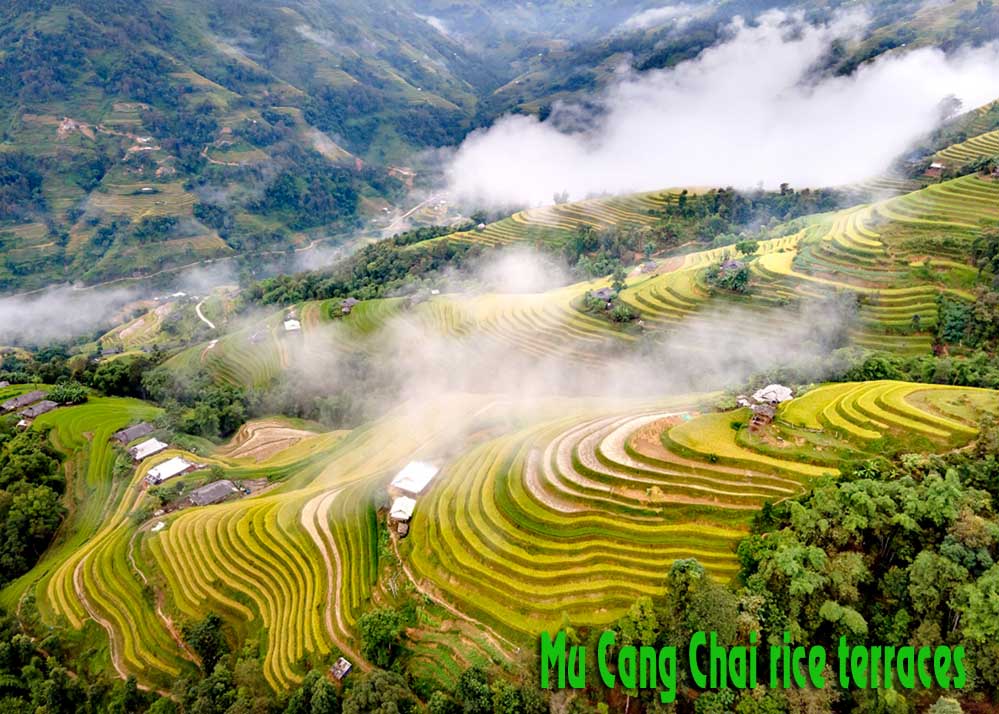
Mu Cang Chai, Yen Bai
When talking about the rice harvest season in Northwest Vietnam, Mu Cang Chai
remains an irreplaceable name. The rice paddies winding around the mountain
slopes in La Pan Tan, Che Cu Nha, De Xu Phinh, or the Mam Xoi and Mong Ngua
hills have long become iconic images of the golden harvest season in the
highlands.
The terraced rice fields are scattered across a wide area, and there is no
single entrance fee for the entire region. Some popular spots, such as Mam Xoi
Hill and Mong Ngua Hill, usually charge around 20,000-30,000 VND per person.
Visitors using local motorbike taxis to reach the higher points may pay an
additional 60,000-100,000 VND for a round trip.
July and August are ideal months for viewing the green foliage. The golden
season is usually concentrated from mid-September to early October, but the best
time can vary from year to year. Visitors should check actual photos before
their trip to avoid arriving too early or after the harvest has already begun.
Mu Cang Chai is a popular choice for tourists due to its large rice paddies,
picturesque landscapes, and numerous famous photo spots. The system of
homestays, guesthouses, restaurants, and motorbike taxi services is also more
developed compared to many other rice-growing regions.
The large number of visitors is an advantage but also creates pressure during
peak season. The fields of Mam Xoi and Mong Ngua are usually crowded from early
morning, especially on weekends. The roads to some of these spots are narrow and
steep, with limited parking; room and service prices also tend to increase when
the rice ripens.
To avoid crowds, tourists can spend more time exploring villages further from
the city center instead of focusing solely on familiar photo spots.
Xim Vang, Son La
Xim Vang is located in the former Bac Yen highlands, now in Son La province.
This destination is often included in the Ta Xua cloud-hunting tour, suitable
for travelers who want to combine multiple experiences in one trip.
The Xim Vang terraced rice fields are located along the valleys and mountain
slopes, and are mostly free to visit. There is currently no general entrance
fee. Some campsites, parking lots, or viewpoints managed by locals may charge
separate service fees.
From July to early September, the terraced rice fields blanket the valleys and
mountain slopes, creating a breathtaking landscape, most beautiful in the early
morning or late afternoon. The rice ripens usually between mid-September and
early October.
Compared to Mu Cang Chai or Sa Pa, Xim Vang hasn't yet attracted a huge number
of tourists. This very solitude has become an attractive feature for young
travelers who enjoy camping, taking landscape photos, or seeking a location less
frequently featured on mainstream tours.
The landscape here is expansive, with few buildings obstructing the view. The
rice paddies stretching at the foot of the mountains create a sense of openness,
especially beautiful in the early morning or late afternoon.
The drawbacks include the long distance, many steep mountain passes, limited
accommodation options, and inconsistent information regarding rice crop
conditions. Visitors should carefully prepare their transportation, fuel, and
accommodation before traveling.
Phung village, Ha Giang
Phung village is located in the Hoang Su Phi terraced rice fields, currently
belonging to Ban May commune, Ha Giang province. From the old Hoang Su Phi town
center, visitors have to travel nearly 30 km along a mountain pass to reach the
village.
There is no unified entrance fee in this area. Some viewpoints or private land
may charge around 10,000-20,000 VND per person. Visitors should inquire before
stopping their vehicles or using pathways through areas managed by locals.
July and August are the months when the terraced rice fields cover the mountain
slopes in lush green. From around the first half of September, the rice fields
gradually begin to turn a golden yellow. If you visit Ban Phung at this time,
you can observe many different shades of color on the mountain slopes.
Phung village is notable for its topography resembling a large basin, with
terraced rice fields surrounding clusters of houses belonging to the La Chi
people. The landscape has many layers, making it suitable for landscape
photographers, those who want to capture sunrises, or those who wish to observe
local life during the harvest season.
Compared to more famous destinations, Phung village has fewer shops, signposts,
and tourist services. This is an advantage for those who prefer tranquility, but
it also means the trip requires more preparation.
The road to the village has many steep sections and can be slippery after rain.
The number of accommodations is limited, so visitors wishing to stay overnight
during peak season should book in advance.
Hoang Su Phi, Ha Giang
Hoang Su Phi is not just a single spot for viewing rice paddies, but a vast area
of terraced rice fields, stretching across many villages such as Nam Hoa, Ban
Luoc, Thong Nguyen, Ho Thau, Nam Ty, and Ban Phung.
Most rice paddies are interspersed with villages and local roads, and no general
entrance fee is charged. Some photography spots, accommodation areas, or
viewpoints operated by locals may charge a fee.
From the beginning of July, the rice fields are lush green, covering the entire
region. The golden season, however, usually begins in mid-September and lasts
until early October. Due to the vast terrain and varying altitudes, the rice in
Hoang Su Phi ripens unevenly. Tourists can encounter fields that are still
green, fields that are golden yellow, and fields that are being harvested all
within the same journey.
Unlike Mu Cang Chai, where tourists tend to congregate at a few iconic spots,
visitors to Hoang Su Phi are dispersed across many villages. As a result, the
overall experience is more pleasant, especially for those who have time to
explore the more remote highland communes.
Some popular resorts and homestays in Hoang Su Phi have already listed their
rooms as fully booked, but the area isn't experiencing widespread overcrowding.
Guests tend to book early for accommodations near the terraced rice fields,
offering expansive views and convenient access to the villages.
The biggest drawback is the long distance, with many small and difficult
sections. If you only have one day, it's difficult to fully appreciate the
beauty of the area. A more reasonable option is to choose a cluster of nearby
attractions, stay at least one night, and use a local guide.
Source:
Best places to admire terraced rice fields in Northern Vietnam
